Henry Rood
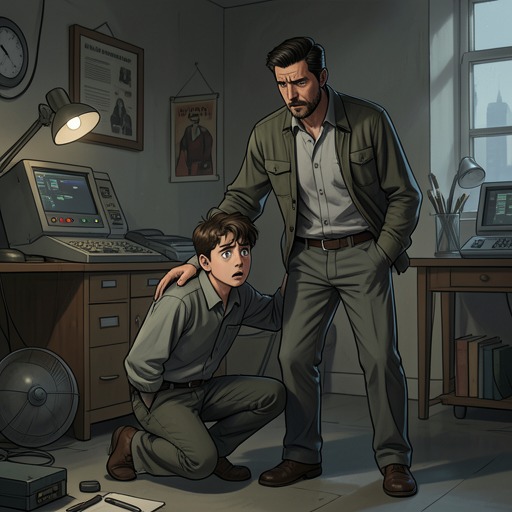
I Know This Much Is TrueHenry Rood is a homeowner whose despair ends in suicide at an attic window while Dominick Birdsey is working at the house. Rood is present in the novel for only a short time, yet the timing and setting of his death entangle it with Dominick’s own fall: rescuers initially mistake Dominick for Rood, and Dominick later remembers Rood’s staring figure as a disturbing presence that follows him beyond the scene.
Identity and Introduction
Rood is introduced indirectly through his wife, Ruth Rood, who calls Dominick after he fails to arrive at their house as expected. Speaking slowly and slurring her words, she explains that Henry is discouraged: scaffolding at his office window has begun to make him feel like a prisoner in his own home, and he is too despondent to work. Her appeal to Dominick presents Henry as a man whose domestic surroundings have become confining, though the scaffolding is a literal feature of the house rather than imprisonment itself. Dominick’s bitter reply sets Rood’s predicament against his own immediate concern: trying to get his brother out of actual prison at Hatch.
When Dominick later arrives, he tells Ruth that he has had an accident and totaled his truck. She barely reacts to his condition. Instead, she turns away on the porch and warns him that it is a bad day to be there because Henry is having a difficult time. She describes him as depressed. Ruth’s attention is fixed on her husband’s distress, while Dominick, already injured and preoccupied, receives her warning without knowing how grave the situation is.
The Attic Window and Suicide
At the house, Dominick sees Rood standing at the attic window and staring. The image is sharpened by the glass, where Dominick sees his own reflection superimposed over Rood’s figure; the two men appear visually joined at the instant Dominick tries to understand the stare. Dominick asks what Rood wants, but receives no explanation. Rood puts a gun in his mouth. Dominick stumbles backward and falls.
The account preserves a crucial distinction between what Dominick witnesses and what he later learns. He remembers the fall but not hitting the ground. According to Miguel’s account of the emergency response, Ruth made a hysterical 911 call, and the arriving EMTs found Dominick unconscious in the front yard, lying on broken shutters. They initially assumed that he was Henry Rood and that his fall was the suicide attempt Ruth had reported. Ruth’s confused and distressed account had to be disentangled before they understood that the man in the attic had fired the gun into his head and that Dominick was a separate, badly injured person.
Rood was pronounced dead on arrival at Shanley Memorial Hospital. Miguel reports that Rood probably died moments after pulling the trigger. Dominick arrived at the hospital in a second ambulance, suffering devastating injuries from his own fall. His leg and ankle were shattered and dislocated, and emergency surgery began that evening. The accident therefore places the two men in parallel but sharply different emergencies: Rood dies at the scene, while Dominick survives and is taken for extensive reconstruction.
Aftermath and the Returning Image
Rood’s death does not remain a closed incident for Dominick. While in the hospital, exhausted and unable to keep up his usual emotional defenses, Dominick wonders whether Ruth has anyone to support her. He remembers Rood at the attic window and asks himself why Rood had to go up there. The thought registers not as a resolution but as a question that persists alongside Dominick’s own pain and disorientation. He acknowledges that Ruth had been decent to him despite the difficulties connected with the house, giving his concern for her a human dimension amid the horror of the suicide.
Later, after returning home from the hospital, Dominick again sees Rood in his mind at the attic window. The image becomes entangled with a cassette and with a woman Dominick calls the Duchess, whom he imagines had allowed Rood to watch intimate encounters. Dominick interprets those encounters through a humiliating suspicion: he feels that he was used as a means to an end, rather than being the focus of the intimacy. This is Dominick’s anguished interpretation, not an independently confirmed account of Rood’s actions. Its importance lies in how the remembered window turns Rood into a figure of imagined observation, deepening Dominick’s feelings of shame and powerlessness.
Dominick has been home for three days and has avoided listening to the answering machine messages. He finally recognizes that he fears hearing Rood’s voice, whether Rood is alive or dead. That fear makes the suicide recur as more than a witnessed death: Rood’s presence has become attached to the possibility of an unwanted message and to Dominick’s inability to regain control over what he remembers. Rood’s brief appearance thus marks a collision between literal confinement, fatal despair, and Dominick’s later sense that his most private experiences have been exposed.